SEO Details
Primary Keyword: Convert Word to PDF Tool
Secondary Keywords:
You have spent hours perfecting a report in Microsoft Word — crisp headings, aligned tables, custom fonts. Then you email it to a client and their reply comes back: "The formatting looks broken on my end." Sound familiar? This is the everyday frustration that makes a Convert Word to PDF Instantly Tool indispensable in modern workflows.
PDF (Portable Document Format) was designed precisely to eliminate this problem. Once a Word document is converted to PDF, its layout, fonts, images, and spacing are locked in — rendering identically on every device, operating system, and screen size. In this complete guide, we cover everything you need to know: how Word-to-PDF conversion works, what to look for in a converter tool, best practices for high-quality output, and how to choose the right tool for your specific use case.
Why Converting Word Documents to PDF Matters
Consistent Formatting
PDFs render identically on every device — fonts, spacing, and layout never shift regardless of software version.
Enhanced Security
PDFs support password protection, encryption, and edit restrictions — keeping sensitive content safe in transit.
Universal Compatibility
No Microsoft Word required. PDFs open natively on any device, browser, or operating system worldwide.
Reduced File Size
Conversion often compresses content, making files faster to email, upload, and share via cloud platforms.
Professional Appearance
PDFs signal finality and polish — the standard for resumes, contracts, proposals, and client deliverables.
Understanding Word vs. PDF: Key Differences
Before choosing a converter tool, it helps to understand exactly what each format is designed to do and where each falls short on its own.
| Feature | Word (DOC/DOCX) | |
|---|---|---|
| Editability | ✔ Fully Editable | ✘ Read-Only by Default |
| Formatting Consistency | ✘ Varies by Device/Version | ✔ Identical Everywhere |
| Security Options | ✘ Limited | ✔ Password, Encryption, Permissions |
| Universal Compatibility | ✘ Requires Word or Compatible App | ✔ Opens on Any Device Natively |
| Best For | Drafting and collaboration | Final distribution and archiving |
| Long-Term Archiving | ✘ Format may become obsolete | ✔ PDF/A standard ensures longevity |

The same document in Word (left) vs. PDF (right) — layout shifts are common in Word across different devices; PDFs are pixel-perfect everywhere.
How Word to PDF Conversion Works
Modern Word to PDF converter tools execute conversion in a matter of seconds, but the process involves several precise technical steps under the hood:
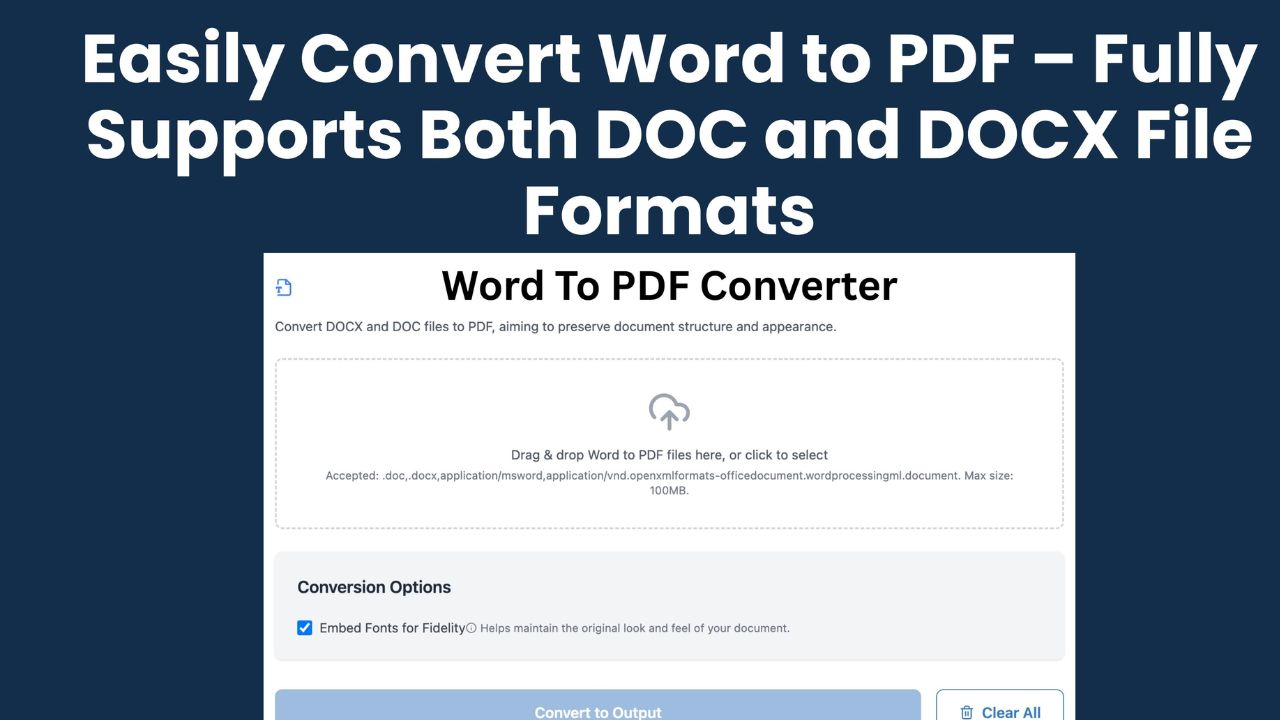
Upload Your Word File
Parse Document Structure
Render Fixed Layout
Generate PDF Output
Download & Share
Step 1 — File Upload
The user uploads a DOC or DOCX file to the converter. Most modern tools accept drag-and-drop, direct upload, and cloud imports from Google Drive, Dropbox, or OneDrive.
Step 2 — Document Structure Parsing
The tool reads every element of the Word document — text blocks, headings, embedded images, tables, headers, footers, page margins, and font definitions. This parsing stage is where quality differences between converters become apparent.
Step 3 — Fixed Layout Rendering
The parsed content is rendered into a fixed-layout representation. This is the critical step that ensures every element will appear identically regardless of the viewer's software or device.
Step 4 — PDF Generation
The fixed layout is encoded into PDF format following ISO 32000 specifications. Advanced tools apply optional optimizations — image compression, font embedding, and PDF/A compliance for archiving.
Step 5 — Download
The completed PDF is delivered for download. Reputable online tools automatically delete uploaded files from their servers within a short window — typically 30 to 60 minutes — to protect user privacy.
Key Features to Look for in a Word to PDF Converter
Not all document conversion software is equal. When evaluating tools, prioritize these features to ensure high-quality, secure output:
Conversion should complete within seconds, even for multi-page documents with embedded images. Any tool taking more than 30 seconds for a standard document is a red flag.
Fonts, tables, images, headers, footers, page numbers, and margins must be preserved exactly. Test with a complex document before relying on any tool for production use.
The ability to convert multiple Word files simultaneously — critical for teams processing dozens of reports, invoices, or proposals at once.
Look for tools that use HTTPS encryption for uploads, do not store files permanently, and provide a transparent privacy policy — especially when converting sensitive business documents.
Seamless import from Google Drive, Dropbox, and OneDrive speeds up workflows significantly — eliminating the manual download-upload cycle.
Control over output file size is valuable when the resulting PDF will be emailed or shared through platforms with size limits.

The six features that separate a reliable Word-to-PDF converter from a basic one — check for all of these before committing to any tool.
Online vs. Offline Word to PDF Tools: Which Should You Use?
Both online and offline converters have their place. The right choice depends on your workflow, privacy requirements, and document volume.
Online Tools
No installation required. Accessible from any browser on any device. Typically free for basic use. Best for occasional conversions and non-sensitive documents.
Offline / Desktop Software
Better privacy — files never leave your machine. Faster for large batches. Advanced features like OCR and digital signatures. Best for high-volume or confidential workflows.
Cloud-Based Enterprise Tools
Team sharing, API access, and automated pipeline integration. Scalable for organizations processing thousands of documents. Includes audit trails and compliance features.
The Best Word to PDF Converter Tools in 2026
The document conversion software market is mature and competitive. Here are the most trusted and widely used tools across different use cases:
Adobe Acrobat
Industry standard. Unmatched format fidelity, OCR, digital signatures, and PDF/A compliance.
Smallpdf
Clean online interface, fast conversion, cloud import support. Free tier available with size limits.
iLovePDF
Free, user-friendly, and feature-rich. Supports batch conversion and multiple PDF operations.
PDF24 Tools
Privacy-focused. Offers a desktop app for fully offline conversion with no file size caps.
Nitro PDF
Professional-grade desktop software. Excellent for enterprise workflows and team collaboration.
LibreOffice
Free, open-source, and fully offline. Export any Word document to PDF with zero privacy concerns.
Real-World Use Cases for Word to PDF Conversion
Understanding where DOCX to PDF conversion adds the most value helps you build it into the right parts of your workflow:
Business Reports & Invoices
Convert reports and invoices to PDF before sending to clients — locking layout and preventing accidental edits.
Academic Submissions
Students submit assignments in PDF to preserve formatting exactly as the instructor will see it.
Legal Documentation
Contracts and agreements in PDF ensure content remains unchanged — critical for legal validity and audit trails.
Resumes & Cover Letters
PDFs guarantee recruiters see your resume exactly as designed, regardless of their device or Word version.
Government & Official Forms
PDF is the standard for official documentation, ensuring consistent rendering across all government systems.
Long-Term Archiving
PDF/A format ensures documents remain fully readable and compliant for decades without software dependency.

Six high-value use cases where converting Word to PDF immediately improves security, consistency, and professionalism.
Best Practices for High-Quality Word to PDF Conversion
Getting a great PDF output starts before you hit the convert button. Follow these practices to ensure accurate, professional results every time:
- Use standard, widely-available fonts — custom or uncommon fonts that are not embedded in the PDF may render as substitutes on other systems. Stick to fonts like Arial, Calibri, or Times New Roman for maximum compatibility.
- Optimize images before conversion — high-resolution images embedded in Word documents can produce very large PDFs. Compress images to 150–300 DPI before inserting them into your Word file.
- Avoid excessive formatting complexity — multiple nested text boxes, complex floating objects, and custom page layouts occasionally produce rendering issues during conversion. Simplify where possible.
- Always review the output PDF — scroll through every page of the converted file before distributing it. Pay special attention to tables, headers, footers, and page break positioning.
- Use a trusted tool for sensitive documents — verify the converter's privacy policy and data deletion practices before uploading any personally identifiable or confidential content.
- Consider PDF/A for archival use — if the document needs to remain accessible for years, export it in PDF/A format, which embeds all fonts and color profiles for long-term reliability.
Common Challenges in Word to PDF Conversion (and How to Fix Them)
Complex layouts with custom text boxes or non-standard page sizes may not convert perfectly. Fix: simplify the layout in Word, or use Adobe Acrobat which has the highest fidelity with DOCX format.
High-resolution embedded images can produce unwieldy PDFs. Fix: reduce image resolution to 150 DPI in Word before conversion, or use the converter's built-in compression options after generating the PDF.
Fonts not installed on the converter's server may be substituted. Fix: use common system fonts, or convert using desktop software (LibreOffice, Word itself, or Adobe Acrobat) that has access to your locally installed fonts.
Uploading confidential files to unknown online tools poses a data risk. Fix: use offline software (PDF24 desktop app, LibreOffice, Adobe Acrobat) for any document containing sensitive or personal data.
Future Trends in Word to PDF Conversion
As document workflows evolve, the tools behind instant file conversion are advancing rapidly. Here is where the technology is headed:
AI-Powered Conversion
Machine learning models will intelligently detect and preserve complex layouts, improving fidelity for multi-column designs and nested tables.
Real-Time Cloud Automation
API-based conversion pipelines will allow documents to be converted automatically as part of larger cloud workflows without human intervention.
Mobile-First Tools
Optimized mobile conversion apps will allow professionals to convert, annotate, and share PDFs entirely from their smartphones.
Enhanced Privacy Features
Zero-knowledge encryption and on-device conversion will become standard for enterprise and regulated-industry workflows.
Benefits at a Glance
External Authoritative Sources
- Adobe Acrobat — Word to PDF — Industry-leading converter with highest format fidelity
- ISO 32000 — PDF Specification — Official international standard governing the PDF format
- Smallpdf — Word to PDF — Popular free online converter with cloud integration
Key Takeaways
- A Convert Word to PDF Instantly Tool locks your document's formatting, fonts, and layout — ensuring identical rendering on every device and operating system.
- PDF conversion adds security options unavailable in Word — including password protection, edit restrictions, and encryption — making it the right choice for any final document you distribute externally.
- The best converters combine instant speed, format fidelity, batch support, cloud integration, and secure file handling — always test with a complex document before relying on a tool for production.
- For sensitive or confidential documents, always use offline software (LibreOffice, PDF24 desktop, or Adobe Acrobat) to avoid uploading private data to external servers.
- Common use cases include business reports, resumes, invoices, academic submissions, legal contracts, government forms, and long-term document archiving.
- Future improvements — AI-powered layout detection, on-device encryption, and real-time cloud automation — will make DOCX to PDF conversion even faster and more reliable in the years ahead.
Conclusion
The gap between a Word document and a PDF is the gap between a draft and a deliverable. Word is the right tool for creating and collaborating; PDF is the right format for sharing, distributing, and archiving. A reliable Convert Word to PDF Instantly Tool bridges that gap in seconds — no formatting headaches, no compatibility surprises, no broken layouts.
Whether you are a student submitting coursework, a freelancer delivering client work, or a business professional sharing reports and contracts, PDF conversion is a workflow habit that immediately raises the quality and professionalism of everything you send. The tools available in 2026 are faster, more capable, and more privacy-conscious than ever before — there has never been a better time to make PDF your default distribution format.
Start with a trusted converter, follow the best practices in this guide, and build the Word-to-PDF step into your standard workflow. Your recipients will notice the difference — even if they never realize why.
Frequently Asked Questions
Q1 Will my formatting be preserved exactly when I convert Word to PDF?
In the vast majority of cases, yes — modern converters preserve fonts, tables, images, headers, footers, and page layouts with high fidelity. The most common exceptions involve documents with custom fonts not available on the converter's server, or very complex floating-object layouts. Always review the output PDF before distributing it, and use Adobe Acrobat or desktop software for documents with intricate formatting.
Q2 Is it safe to use online Word to PDF converters for sensitive documents?
Reputable tools like Smallpdf, iLovePDF, and Adobe Acrobat Online use HTTPS encryption for all uploads and automatically delete files within 30–60 minutes of conversion. However, for documents containing personal data, financial records, medical information, or legally privileged content, always prefer offline software such as LibreOffice, PDF24's desktop application, or locally installed Adobe Acrobat — where files never leave your machine.
Q3 Can I convert Word to PDF without Microsoft Word installed?
Yes. All online converters work entirely in the browser — no software installation required. Offline alternatives like LibreOffice (free and open-source) and PDF24's desktop app also convert DOCX files to PDF without requiring a Microsoft Word license. This makes PDF conversion accessible on any operating system, including Linux and ChromeOS.
Q4 What is PDF/A and when should I use it?
PDF/A is an ISO-standardized version of PDF specifically designed for long-term archiving. It embeds all fonts, color profiles, and metadata directly into the file — ensuring the document remains fully readable decades from now, regardless of what software exists in the future. Use PDF/A when converting documents intended for legal records, regulatory compliance, government archives, or any situation where the document must remain accessible indefinitely without relying on external resources.
Q5 How do I reduce the file size of a converted PDF?
Large PDF file sizes are almost always caused by high-resolution embedded images. The most effective fix is to reduce image resolution to 150 DPI inside the Word document before conversion. Alternatively, use the compression feature included in most converter tools after generating the PDF, or run the output through a dedicated PDF compressor like Smallpdf's Compress PDF tool. For documents with no images, the converted PDF will typically be similar in size to the original DOCX file.
Convert Your Word Document to PDF Instantly
Use TecByte's free online Word to PDF converter — no account required, no file size limits for standard documents. Upload, convert, and download in seconds.
Try Word to PDF Converter Free